
How Hiromi Paper Simplified B2B Wholesale Member Pricing and e-commerce Sales Across POS and Online Channels
About Hiromi Paper
Based in Los Angeles, Hiromi’s expertise lies in Japanese washi and specialty papers for artists, printmakers, bookbinders and other creatives. With both a physical store and an online shop, customers can browse and buy in person or online, with members receiving special pricing.
As Hiromi catered to different types of customers across both channels, managing its pricing and order processes came with a few complexities. Hiromi wanted to make it easier for members to shop, without adding more work for the team behind the counter.
The Challenges of Managing Orders Across Channels
The biggest issue was the handwritten invoices, which we needed to transition out of to improve productivity and reduce human errors. The first step was to start using POS in the store, and the next challenge was to create a system where members could place their orders online.
Too much manual work at the billing counter
On a regular day, ringing up member orders at the POS was quite a tedious manual process for Hiromi. At the counter, staff worked out member prices by hand, calculated each member’s cart discount and applied it as a discount in the Shopify POS.
Online, the process took even longer. While members could browse the product catalog online, they couldn’t receive their member discounts when placing orders through the online store. As a result, members had to place orders over the phone, with staff writing down order details and preparing invoices manually. This took time away from other tasks and left room for calculation errors.
The team needed a way to take the manual work out of member pricing at the counter and give customers a more convenient way to order online.
Getting the Right Prices for Different Products
Hiromi’s pricing wasn’t a single discount that applied across the entire cart. What a member paid depended on the product:
- Paper was priced by quantity breaks: Each paper had a fixed member price for each quantity band, so the price depended on how many sheets the member bought.
- Regular-priced stock papers and conservation supplies got an order-value discount: Products without a member price got 10% off when it’s subtotal was over $20, and 15% off at $50 or more.
Both discount logic had to be applied in the order, without discounting the same product twice. On every member order, staff had to separate the paper from other products, apply the relevant tier-based price, and then work out the discount on non-paper products. During busy days, the additional steps slowed things down at the counter and led to longer queues.
Additionally, maintaining the price lists added to the workload. Product assignments had to be checked manually, and annual price updates took up an entire day.
The Solution
Instead of working out member discounts order by order, Hiromi uses two Dollarlabs apps to manage its different pricing requirements. Dollarlabs B2B Price List handles fixed, quantity-based prices for paper, while Dollarlabs: Ultimate Discounts manages order-value discounts on other products. Together, they bring Hiromi's member pricing into one setup across Shopify POS and the online store.
Managing Paper Prices by Quantity
Each paper family has a member price list in Dollarlabs B2B Price List, with fixed prices for different quantity bands. Members pay the price specified on the member sheet, rather than a percentage off retail.
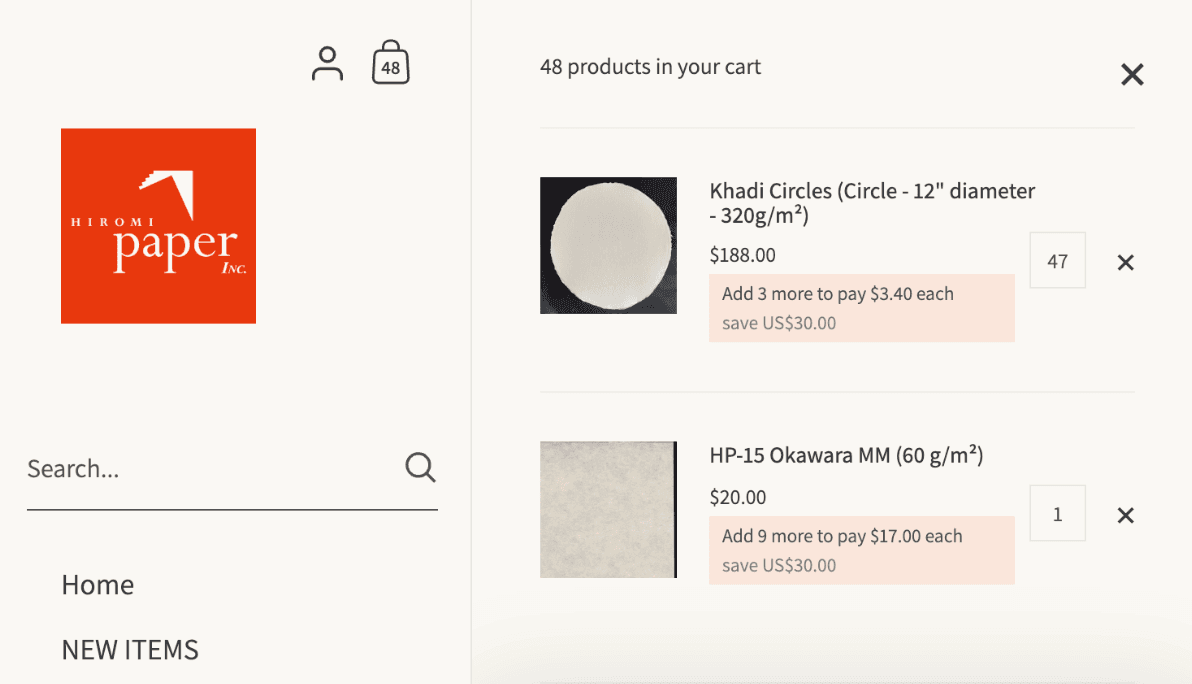
The quantity breaks are shown in the cart as well. Using the UI SDK for Storefront, the cart reads the next band straight from the member price list and shows how many more are needed and what they would save.
Using bulk import for spreadsheets, they were able to easily update and manage extensive price lists without entering every price individually.
An order-value discount on qualifying products
With Dollarlabs: Ultimate Discounts, the rules are configured once and applied automatically at checkout based on the member’s order value.
What counts: Only regular-priced stock papers and conservation supplies, not the whole cart.
The discount: 10% off when those products come to over $20, and 15% off over $50.
What's left out:
- Products with configured price lists in the DL: Wholesale & B2B price are excluded.
- Books, book cloth and special-order papers.
Who gets it: Members only
Customer tags identify members, while product exclusions ensure each discount applies only where it should. The same rules work across Shopify POS and the online store, without requiring a separate POS extension.
The Result: Less Manual Work, Fewer Errors, and More Time for the Team
One of Hiromi's biggest concerns before the move was whether all its discount rules would work together correctly. The new setup addresses this, allowing quantity-based paper prices and order-value discounts on other eligible products to work within the same cart. Since the migration, Hiromi has been able to efficiently handle member orders, both online and in-store.
More time to spend working on other duties, not having to answer the phone to manually take down orders. I’m sure it’s great for members who don’t need to call in every time they want to place an order, they can just place their orders online at their own convenience.
Orders are processed through the standard Shopify cart and checkout, and staff no longer need to calculate discounts manually. At the counter, staff select the member in Shopify POS, and the relevant discounts are applied automatically. Online, members sign in to view their member prices and place orders themselves.
Phone and email order can still be handled when needed with draft orders. Staff can create a draft order in Shopify Admin, select the member and products, and enable “Apply all eligible automatic discounts.” That way, member's eligible discounts are applied before the invoice is shared.Nothing is priced or invoiced by hand.
The change has made a difference to everyday operations:
Fewer calculation errors: Moving away from handwritten orders and manual calculations has reduced calculation errors.
More time for the team: Staff spend less time taking orders over the phone, leaving more time for other responsibilities.
Simpler price list maintenance: The existing paper price sheets have been imported through spreadsheets, rather than entered product by product. With annual updates previously taking an entire day, this provides a more structured starting point for the next update.
For Hiromi, this shift was more than just implementing discounts. It was about making member pricing easier to manage and giving both staff and customers a better way to handle everyday orders.